PM Modi Inaugurates 300 MW Solar Plant in Rajasthan

PM Modi Inaugurates 300 MW Solar Plant in Rajasthan

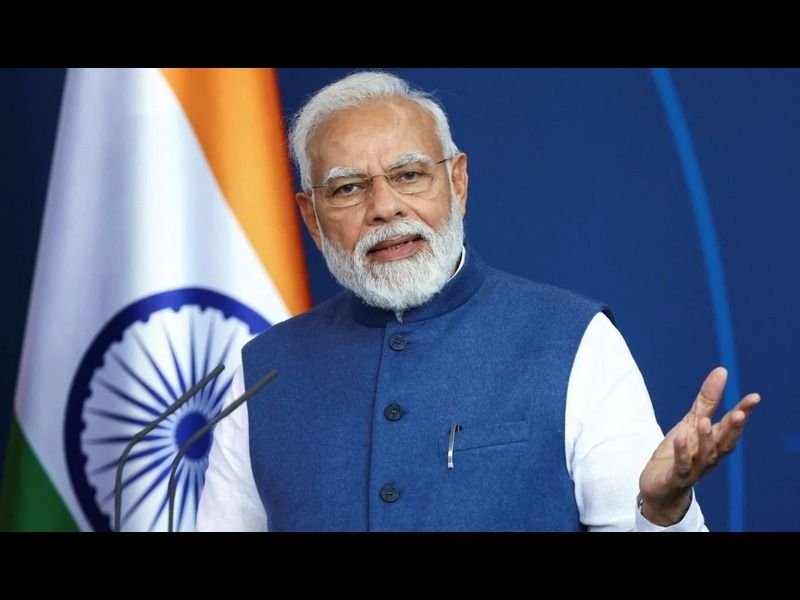
Prime Minister Narendra Modi on Friday inaugurated a 300 MW solar power plant in Rajasthan, marking a significant step towards achieving the government’s ambitious renewable energy capacity addition target and the goal of net-zero by the year 2070.

A green and cheap power project

The solar power plant, located at Karnisar-Bhatiyan village in Bikaner district, is being set up by NHPC Limited under the central public sector undertaking (CPSU) scheme, phase-II, tranche-III, with a total investment of over Rs 1,732 crore.

The project is equipped with cutting-edge technology, including high-efficiency bifacial modules manufactured in India, aligning with PM Modi’s Atma Nirbhar Bharat initiative.

The electricity generated by the project will flow through the Bikaner-II inter state transmission system substation, aiming to produce an impressive 750 million units of green power annually, considering a capacity utilization factor (CUF) of 28.50%.

This substantial output is projected to offset carbon dioxide emissions by approximately 18,000 million metric tonnes over the project’s 25-year lifetime.

The power usage agreement for the project has been formalized with Punjab State Power Corporation Limited (PSPCL) at a competitive tariff of Rs 2.45 per unit for 25 years, considering viability gap funding (VGF) of Rs 134.70 crore offered by the Ministry of New and Renewable Energy, Government of India.

The project is scheduled for commissioning by September 2024.

A boost to employment and development

The project also has the potential to create employment opportunities for approximately 600 individuals indirectly during the project phase and 100 personnel during the operations and maintenance phase.

Furthermore, as per the provisions of solar policy of the state, the Government of Rajasthan will also get a contribution towards Rajasthan Renewable Energy Development Fund for development of large power system infrastructure for grid management, other supporting infrastructure and facilitation works for the stakeholders.

A milestone in India’s renewable energy journey

Speaking at the inauguration ceremony, PM Modi said, “India has started moving at a fast pace in generating solar power, and in giving an impetus to this mission, today, we have inaugurated various solar power projects in Rajasthan. The projects will not only provide green and cheap power to the region but also provide great employment opportunities to the youth.”

He added that India is committed to increasing its renewable energy capacity to 450 gigawatts by 2030 and achieving net-zero emissions by 2070.

He also praised the state of Rajasthan for its leadership in solar energy generation and said that it has become an inspiration for other states.

The function was also graced by Chief Minister of Rajasthan Bhajan Lal Sharma; Union Minister for Power and New and Renewable Energy R. K. Singh; Union Minister for Law and Justice and Member of Parliament from Bikaner Arjun Ram Meghwal; Deputy Chief Minister of Rajasthan Diya Kumari; Minister of State for Power and Heavy Industries Krishan Pal Gurjar; and Deputy Chief Minister of Rajasthan Prem Chand Bairwa.

Recent Blog : Prabhaav : SIDBI’s Insight into Fund of Funds for Startups

Share:

MORE STORIES

## Navigating the AI Revolution: 5 Trending Google Ads Topics for Marketers As Google Ads continues its rapid evolution, staying ahead of the curve is paramount for digital marketers. The platform’s increasing reliance on artificial intelligence, shifting privacy landscapes, and the introduction of new campaign types are creating a fresh set of challenges and opportunities. Here are five top trending blog topics that delve into the most critical areas of Google Ads today. ### 1. The Rise of the Machines: Mastering AI-Powered Campaign Types Google is unequivocally betting on AI to drive the future of its advertising platform. A key area of focus for marketers is understanding and mastering AI-driven campaign types like Performance Max and Demand Gen. These campaigns automate targeting, bidding, and ad creation across Google’s entire inventory. A deep dive into strategies for providing the right inputs to these “black box” models, interpreting their performance, and understanding how to guide the AI for optimal results is a crucial topic for advertisers looking to succeed in this new era. ### 2. Beyond the Click: Navigating the New Landscape of Measurement and Attribution With the impending deprecation of third-party cookies and a growing emphasis on user privacy, the way advertisers measure success is undergoing a fundamental shift. This has propelled topics like enhanced conversions, consent mode, and the integration of first-party data to the forefront. Marketers are actively seeking guidance on how to implement these privacy-centric measurement solutions to gain a more accurate and holistic view of their campaign performance in a world without granular user tracking. ### 3. Creative is the New Targeting: Leveraging AI for Compelling Ad Experiences In an automated world, the creative has become a key differentiator. Google is investing heavily in AI-powered tools that can generate and optimize ad copy, images, and videos. Blog posts that explore how to effectively use these generative AI features to create a high volume of diverse and engaging ad creatives are gaining significant traction. This includes best practices for providing creative inputs, A/B testing AI-generated assets, and ensuring brand consistency across automated campaigns. ### 4. The Evolution of Search: Adapting to a More Conversational and Visual SERP The traditional keyword-based search is evolving. Users are increasingly employing longer, more conversational queries, and Google is responding with a more visual and AI-driven search engine results page (SERP). This shift requires a re-evaluation of traditional keyword research and bidding strategies. Trending discussions revolve around how to adapt to this new reality, including the role of broad match keywords, the importance of high-quality creative in visual search formats, and strategies for capturing intent in a more conversational search landscape. ### 5. Future-Proofing Your Strategy: The Growing Importance of a Full-Funnel Approach As automation takes over many of the manual levers within Google Ads, the focus is shifting towards a more strategic, full-funnel marketing approach. Advertisers are looking for insights on how to effectively use different Google Ads campaign types to guide users through the entire customer journey, from initial awareness to final conversion and retention. This includes discussions on how to structure campaigns to complement each other, allocate budgets across the funnel, and measure the impact of upper-funnel activities on bottom-line results.

Google Ads is in the midst of a quiet revolution—one driven by artificial intelligence, privacy-first regulations, and a rapidly changing search landscape. For digital marketers,

Send Us A Message